
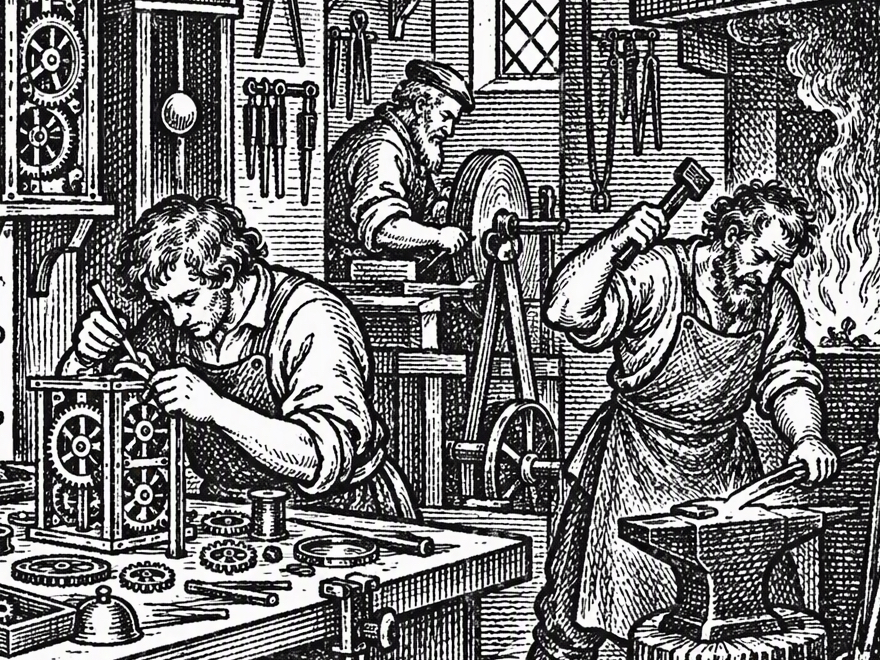
How hammers and anvils evolved into horological tools as we recognise them today
A watchmaker’s bench can seem an unlikely place to begin a history of precision engineering. There are no great machines, no computer-controlled cutting tools and no banks of electronic instruments. Instead, there are files, gravers, drills, punches, saws and a small lathe; objects that, at first glance, appear almost primitive.
Yet these simple tools made possible one of the most remarkable developments in mechanical engineering, the creation of a machine small enough to fit in the palm of the hand, yet capable of dividing time into hours, minutes and eventually seconds.
Before there was a watchmaker’s lathe, there was a file. Before there was a wheel-cutting machine, there was a saw and a skilled hand. Before precision could be measured in microns, it had to be imagined, attempted and repeatedly corrected by craftsmen working with tools that were often little more than extensions of their own hands. The history of horological tools is therefore also a history of precision itself.
The problem of making time portable
By the sixteenth century, mechanical clocks had already become established objects of considerable sophistication, but the emergence of the portable watch presented an entirely different engineering challenge. The mechanism had to be dramatically reduced in size while continuing to perform the same fundamental tasks, that is to store energy, transmit it through a train of wheels and regulate its release.
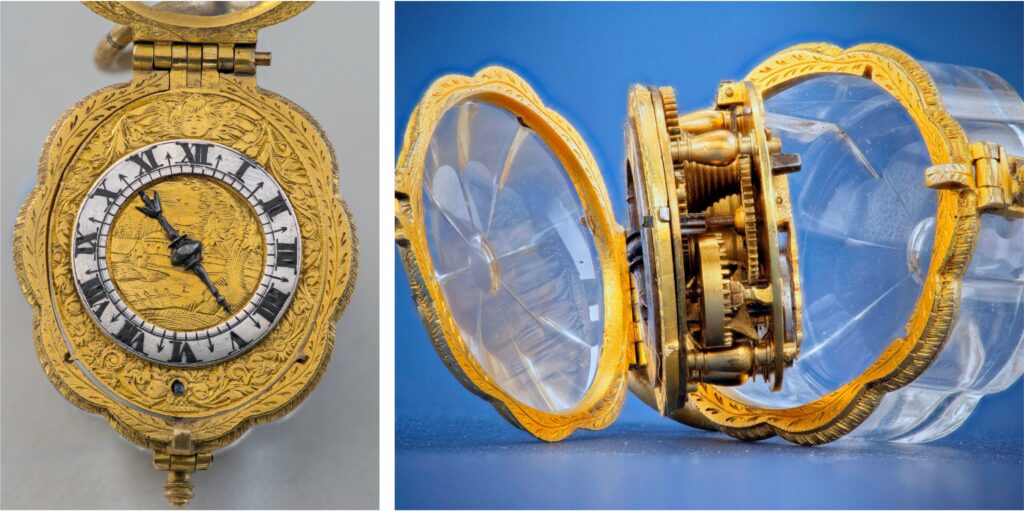
The earliest portable watches were objects of status and display rather than instruments of precision, as they ran +/- 30-mintues per day, and only having an hour hand to mark the time. Their movements were nevertheless feats of miniature metalworking.
The watchmaker therefore needed something more than the tools of the blacksmith or general metalworker. Components had to be smaller, surfaces flatter, holes more accurately positioned and pivots more perfectly cylindrical. The solution was not a single invention, it was an expanding vocabulary of tools.
The tools of the early craftsman
Much of the early watchmaker’s equipment would be familiar to any skilled metalworker, namely a hammer, anvil, files, saws, punches, chisels and drills. Their transformation into horological tools came through scale and application.
A file could remove metal, but the watchmaker needed to remove very small quantities of it while maintaining a controlled shape. A drill could make a hole, but that hole might be required to accommodate a pivot only a fraction of a millimetre in diameter. A saw could cut brass or steel, but the cut had to be sufficiently controlled to produce a component that would ultimately work within a carefully calculated train.
The craftsman’s eye and hand consequently became part of the measuring system. Among the most important tools was the graver, a small cutting tool held by hand and supported against the workpiece. Used with a lathe, it allowed the watchmaker to turn, shape and finish small components. The principle sounds simple, but it demanded considerable dexterity. The tool was not merely cutting metal; the craftsman was controlling the geometry of the finished component through pressure, angle and movement.
The bow drill operated according to an equally simple principle. A bow and cord converted a reciprocating movement into rotation, allowing the craftsman to drill holes without the need for a powered machine. Surviving examples show how such equipment could be incorporated into the working environment of the clock and watchmaker. The Dominy Collection, for example, preserves bows, barrel drills, braces and breastplates used for drilling brass, iron and steel.
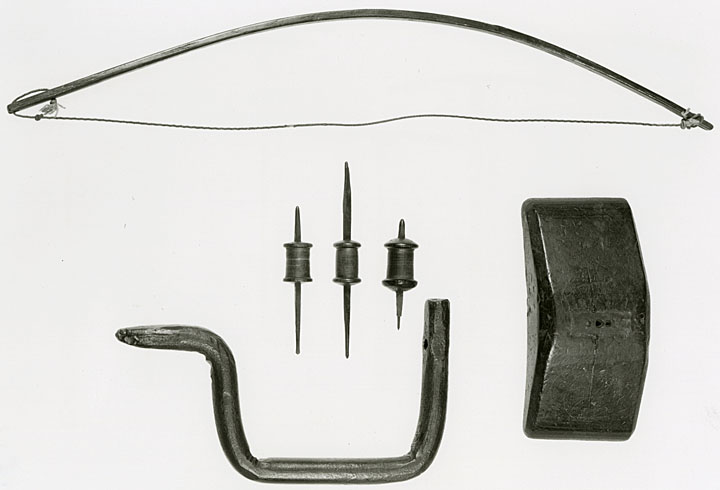
It is easy to underestimate such tools because their operating principles are so straightforward. Their significance lies in what they enabled.
The emergence of the turning tool
One of the most important developments was the adoption of the lathe or ‘turn’. Turning had been practised by craftsmen for centuries, but the watchmaker required a much smaller and more controllable form of the machine. A small workpiece could be mounted and rotated while the craftsman applied a cutting tool to its surface. This opened possibilities that were difficult to achieve by hand alone.
Cylindrical components could be produced with greater regularity. Pivots could be shaped and polished. Small arbors could be turned. The ends of screws could be formed. Surfaces could be reduced gradually until the desired dimensions were achieved.
The principle remained essentially the same whether the power came from a bow, a treadle or, later, a motor to rotate the work and bring a cutting tool into controlled contact with it.
The early watchmaker’s turn was therefore more than another tool. It represented an important change in the relationship between craftsman and material. Instead of simply removing metal with a file, the watchmaker could make the workpiece itself move in a controlled way.
A machine small enough for the bench
By the eighteenth century, the specialist watchmaker’s lathe had become an increasingly important part of horological manufacture. Surviving examples illustrate just how compact these machines could be.
A watchmaker’s turn in the Science Museum collection, dating from the late 18th century, was designed to be clamped in a vice and operated using a bow. The museum notes that increasing specialisation within the London trade created a growing demand for precision tools and machinery as watch production expanded.
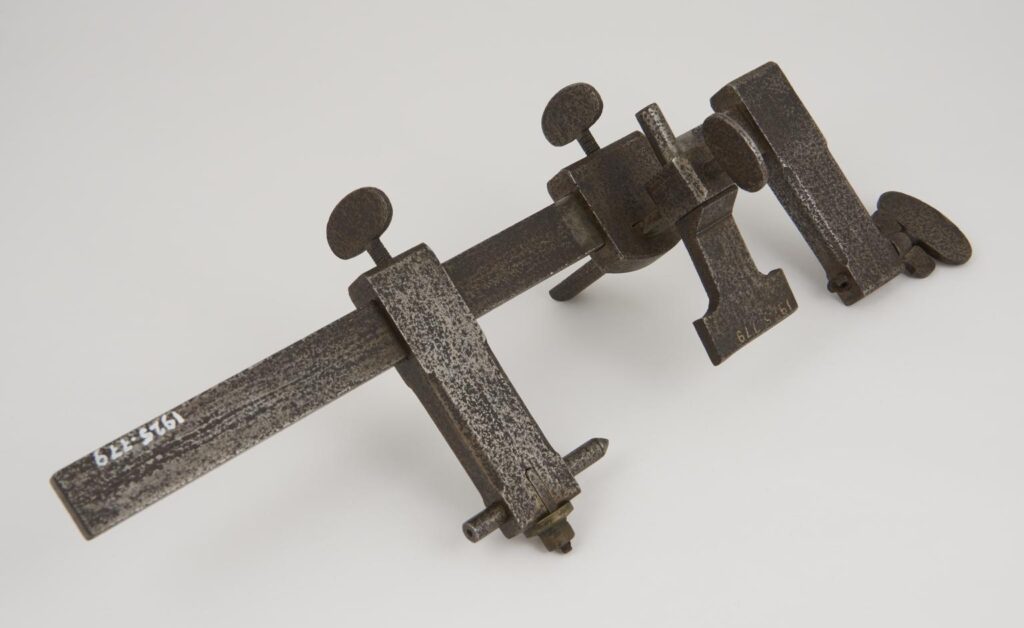
Although this example belongs to a later period than our story, it provides a useful glimpse of the direction in which the seventeenth-century watchmaker’s bench was heading towards increasingly specialised tools designed specifically for the miniature work demanded by horology.
The significance is not simply that the lathe made work faster. It made certain forms of precision practical.
The bench as a workshop in miniature
The watchmaker’s bench gradually became an ecosystem. There was the vice for holding the work, the file for removing material, the saw for cutting it, the punch for forming or positioning it, the screw plate for external screw threads, the drill for piercing it and the graver for finishing it. Measuring and marking tools allowed the craftsman to reproduce dimensions, while the developing lathe provided a means of producing cylindrical forms with increasing consistency.
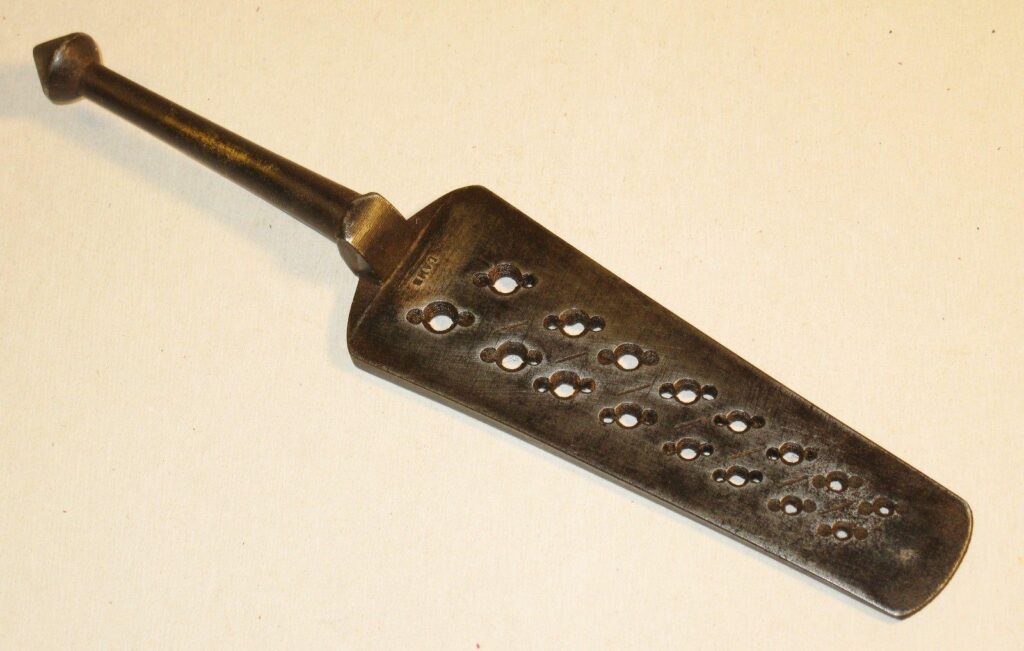
The tools worked together. A wheel might be sawn from a sheet of brass, filed to shape, mounted for further work and then finished with increasingly specialised equipment. A pinion could be turned, and its pivots formed before being fitted into the movement. Screws could be produced, adjusted and finished by hand.
This is one reason why the early watchmaker should not be thought of simply as an assembler of purchased components. The division of labour that would later transform the industry had not yet reached its full extent. The individual craftsman needed a broad range of skills and an equally broad range of tools.
Each element of a clock or watch was made by an expert craftsman. The skills required to make a spring were very different to making a pinion or bell. The Master would sign the piece, but without a team of skilled Journeymen they wouldn’t have a business.
From clock to watch
The seventeenth century also witnessed an important change in the scale and sophistication of English horology.
The work of makers such as Thomas Tompion illustrates the increasingly sophisticated standards being pursued. Tompion’s clocks were not simply decorative objects; some were made specifically to serve as reference instruments and work on demand. A good example of this was the Selby Lowndes clock made by Tompion in c.1693. It is one of the very earliest full grande sonnerie clocks, capable of striking the hours and the quarters, but it also could do this on demand.
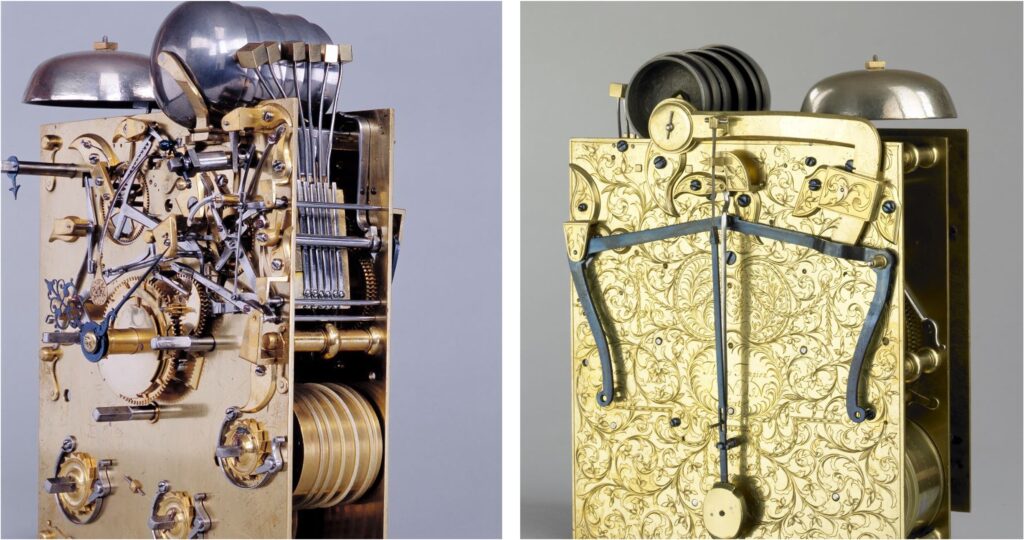
This is an important distinction. The development of precision timekeeping required not only better clocks and watches but better ways of making and testing them. The tool and the timepiece therefore evolved together.
As makers demanded greater accuracy from their movements, they placed greater demands upon the tools used to construct them. Those tools, in turn, encouraged new methods of manufacture. It was a feedback loop that would accelerate dramatically during the eighteenth and nineteenth centuries.
The beginning of specialised machinery
By the early eighteenth century we can see increasingly clear evidence of the movement towards specialist horological machinery.
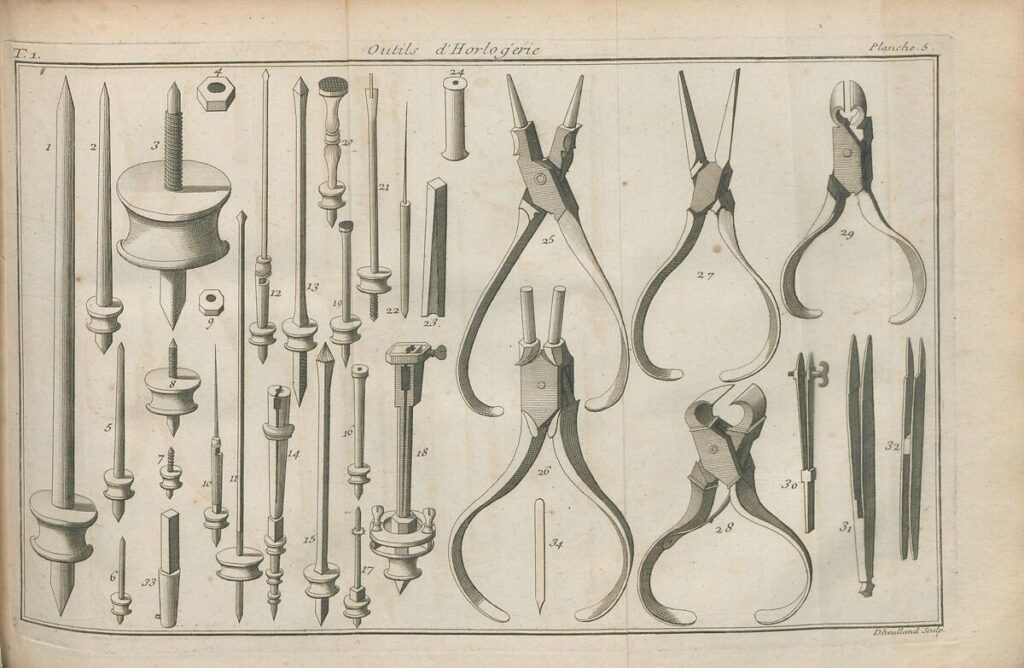
Antoine Thiout’s Traité de l’horlogerie méchanique et pratique, published in Paris in 1741, is particularly revealing. Its illustrated plates document not only clocks, watches and escapements but also the tools and machines used to manufacture them. The work includes descriptions and illustrations of lathes, machines for cutting pinions and equipment for producing fusees.
It’s hard to believe that all these tools would have had to made by the watch and clockmakers before they could actually make their timepieces.
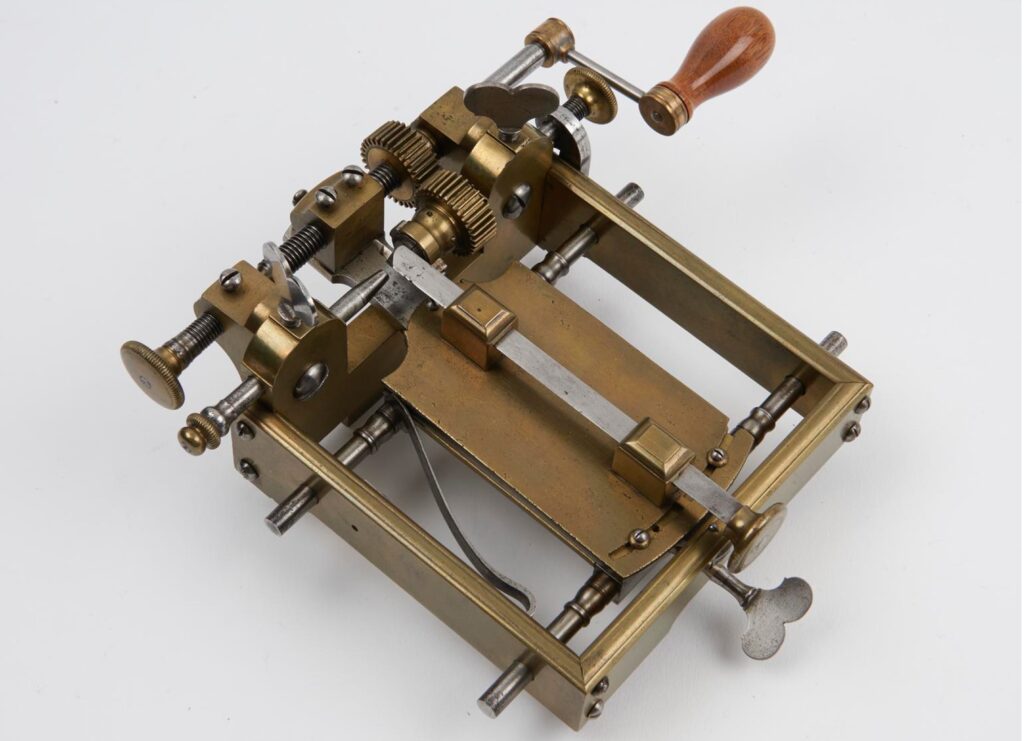
I was fortunate to see one incredible surviving example in the Galileo Museum in Florence, when I visited the Italian Hours exhibition. The beautiful machine, whose components are exquisitely crafted, is signed “Giacomo Amoretti feraio in San Pancrazio Anno 1769” (Giacomo Amoretti, blacksmith in San Pancrazio, in the year 1769) and used in the workshop of Giuseppe Kohlschitter, clockmaker-machinist of the Royal Astronomical Observatory of Brera in Milan.
We have therefore arrived at an important threshold. The tool is no longer simply an instrument in the craftsman’s hand. It is beginning to embody a mechanical principle.
The coming age of precision
The seventeenth-century watchmaker could not yet rely upon the sophisticated machinery that would later define industrial horological production. There was no CNC machine, no optical comparator and no electronic measuring equipment, but the foundations were already being laid.
The transformation began with a deceptively simple idea, if a craftsman could control the movement of a tool more precisely, he could control the shape of the component more precisely.
The file became finer, the graver became more specialised, the drill became smaller, the lathe became more accurate, and the bench became a place where increasingly complex machines could be created using increasingly precise tools such as the fusee cutting engine.
This was the beginning of a process that would ultimately lead from the hand-forged tools of the early craftsman to the precision machine tools of the Industrial Revolution, and eventually to the computer-controlled and laser-based manufacturing systems of modern watchmaking.
The tools may have changed almost beyond recognition, the objective has not. To make a machine capable of measuring time, the horologist first had to learn how to measure the material from which it was made.
Next month: The Golden Age of the Watchmaker’s Bench, how it transformed the humble toolkit into an increasingly sophisticated arsenal of precision and the moment when the simple tool begins to become a specialised machine.