
November 1928 cover of Science and Invention magazine
Watchmaker Rob Nudds on dead horses, colour changes and expecting better of the watch world at large
When it comes to watchmaking, the word “innovation” conjures a certain image in my mind.
It is the image of a very dead horse, tied to a post, being relentlessly flogged by a crazed maniac who seems intent on grinding the poor thing to dust. Let’s follow this macabre scene to its grisly end. Let’s say this crazed maniac succeeds. Still, he swings his flail, pounding dust into dirt, whooping with self-assured enthusiasm as he does so.
The rest of us watch in horror. What is he doing? Does he think we can’t see what he’s done?
If you asked him, he would tell you he was simply flogging a horse (a questionable pastime in 2026, as it is), and probably continue to mash what remains of it into the earth. We, the observers, might feel emboldened to point out that while what he had begun flogging had indeed been a horse, it no longer retained enough identifiable characteristics to be referred to as such.
In this analogy, he doesn’t even break swing…
Words are a funny thing. They evolve as their users and usage need them to. Every year, a handful of neologisms make their way into the dictionary, ratified by the powers that be as real and proper words. And while I have no problem with new words for new things, or even novel visceral descriptors that fill the odd curious gap in the richest of all languages (I’ll acknowledge my bias, but I actually do think English wears that crown). But when a perfectly good word with no satisfactory synonym is hijacked by an industry and used so ubiquitously, so inappropriately, and so carelessly that it ceases to mean what it meant, I do tend to get a bit pissy (and yes, pissy is in the dictionary now).
We hear it every day. Watchmaking thrives on innovation. But often do we actually see it?

I’ll admit, as a WOSTEP-trained watchmaker who’s had the good fortune to work in more facets of the industry than most, I have unreasonably high expectations of everyone I meet working in this trade. I assume, to my own discredit, that everyone working in watchmaking had to fight tooth and nail as I did to get my shot and, therefore, are fellow watch people.
However, as you will probably know from your own field of work, even passion-driven industries like watchmaking, for many people, their job is just a job. They don’t really know all that much about watchmaking. If they’re being honest, our quirky endeavours in micro-mechanical engineering don’t really make them feel much. Worse still, they may not really care about our craft at all.
And yet, they are tasked with a job: to communicate a product. So, what would you do? You’d research other brands’ press releases, website text, and official communication style, and you would look for replicable patterns, a repeatable structure, a tone of voice, and, most crucially, buzzwords, and then you’d hoover up all that information and cobble together your own press kit.
These people, whether they like it or not, are effectively ChatGPT with a heartbeat (and a salary).
And so, we get the mindless regurgitation of the same words: unique (when they mean special, characterful, or even different); iconic (when they mean important, memorable, or popular); innovative (when they mean navy blue).
There was a funny moment that occurred recently during Geneva Watch Days. It was “funny haha” and also kind of “sad funny”. It sired a wry smile and a somewhat maudlin epiphany, occurring simultaneously and resulting in indigestion.
It was while visiting Hautlence, who deserve an honourable mention for the Kubera, one of my top three watches on display, despite it not technically being new for GWD 2026. Before we sat and talked at length with Marcus Eilinger (a titan of watch design known for the H. Moser Streamliner as well as the aforementioned Kubera), one of the booth stewards laid a tray of watches before us, covered with a cloth. With a proud flourish, she whipped away the cloth to reveal…absolutely nothing.
Taking the opportunity to fawn over the Emperor’s New Clothes, I cooed and oohed in wonder, before breaking out into laughter that luckily came across as genuine enough to ease her embarrassment.
“I’m so sorry,” she said, still a little flustered, but seeing the funny side.
“No problem,” I said. “It’s the most innovative presentation I’ve seen so far.”
And so, the term has transitioned from genuinely important into a buzzword and finally into a joke. We need to demand more from innovation. To meet the standard for the term, it must come close to the definition of the word. Let’s take the UNESCO definition for clarity, because it’s a nice one, and accurately pinpoints what we expect from it in the context of watchmaking:
Innovation is the process of creating, improving, or implementing new ideas, methods, or products to solve problems or enhance efficiency.
Now, in my opinion, that definition is pretty broad. It’s a kind definition. It is forgiving. I therefore don’t see how anyone feels they can get away with calling a new colour innovative. Yes, that’s the most extreme example, and I won’t name names for the sake of diplomacy, but if you’re deep into the industry, you can probably recall a few brands guilty of just this.
The key word is new. An improved clasp with a micro-adjust could be innovative if it were genuinely new. Simply copying another brand’s ingenuity is fair enough in improving your own watches. If it’s the best way to add that function to your line without disrupting your key aesthetic or blowing the budget, I have no gripe with that kind of cherry-picking at all. But unless you invented it, unless you brought it to market, unless you are the leader in whatever space in which you’re purporting to lead, please, don’t call it innovative. It cheapens the achievements of others – and yours – when they deserve to be extolled.
With that article-sized rant out of the way, I’ll get down to the brass tacks (or heart) of what I originally sat down to write about: what true innovations did I see at Geneva Watch Days 2026?
Let me be clear: I did not visit every single one of the 71 brands officially showing their wares. I did not visit every pop-up around town. I had around 50 meetings in total, and of those 50, these three things really stood out to me.
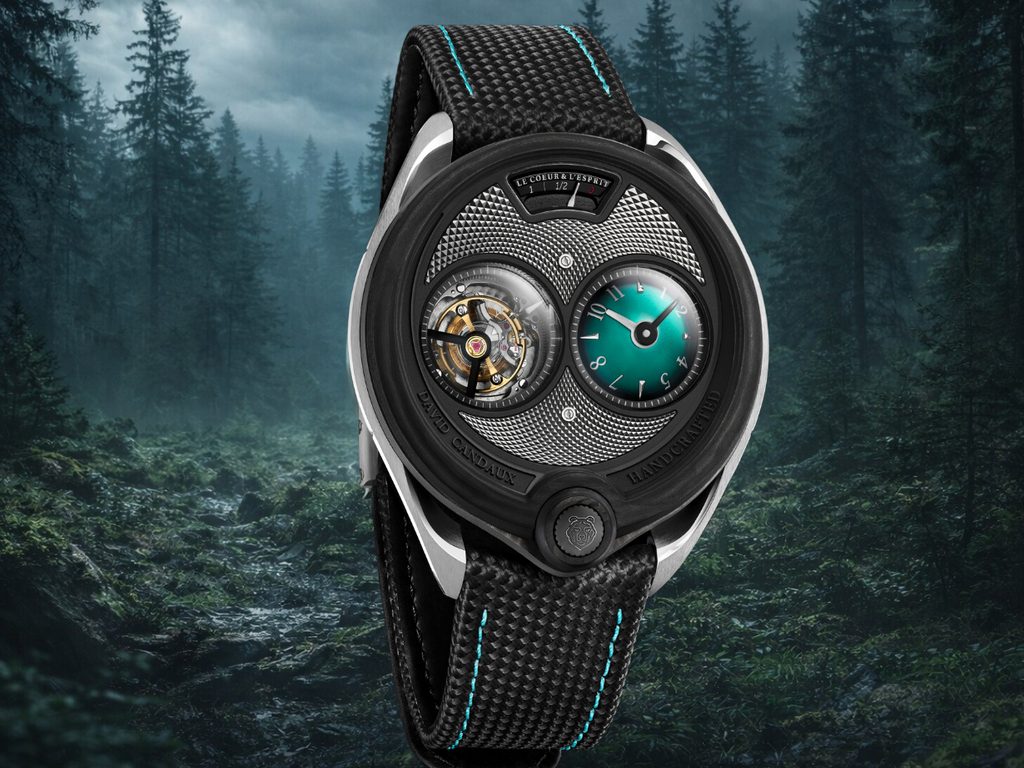
David Candaux’s Crown System
Now, this isn’t a novelty for this fair. In fact, it’s been around for nine years, debuting at Baselworld 2017. However, this is the first time I had the chance to meet the man himself, discuss the challenges he faced in bringing his genius concept to life, and to play with every crown of every watch he had on show. Simply put, this innovation is not talked about enough. The pop-out crown may well be positioned with near-vertical engagement on Candaux’s models, but this concept could be deployed in more traditional, horizontal setups and used with non-round crowns, opening an entirely unexplored world of aesthetic possibilities. When you really study the technical drawings, it seems even more impressive.
This, I believe, is a perfect example of an innovation. It fulfils all the criteria and has no obvious corollary on the market, and its use in David Candaux’s new DC6 Night Forest continues to give me hope for the watch world.
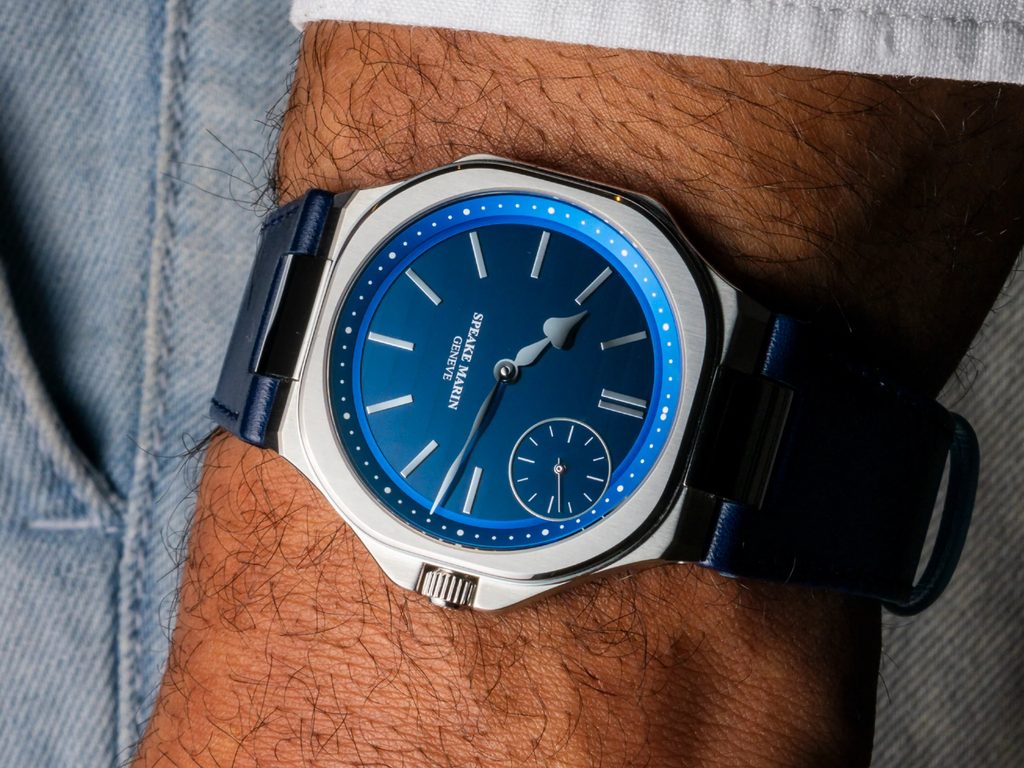
Speake-Marin KÁRMÁN LINE Dial Decoration
This feels like an odd choice for me, having never fallen head over heels for the case shape of Speak-Marin’s take on the integrated sports watch, but credit where credit’s due. This ultra-thin timepiece uses an innovative laser-engraving technique to apply Geneva stripes to the underside of the sapphire dial. Engraving into sapphire has happened before. That bit is nothing new. But merging an ultra-modern decorative technique with such a traditional pattern and executing it on a 0.5 mm thick sapphire wafer used as a dial? That’s pretty impressive. I’ve worked with sapphire crystals in aesthetic roles as thin as 0.3 mm thick. They are so thin and so fragile that you only have to look at them funny for them to break. While 0.5 mm thick isn’t much thicker in absolute terms, it is a 67% increase, which clearly adds sufficient stability for the lasering process, but then to cut into that sliver of sapphire and it not break? Chapeau.
I’ve been a big fan of using sapphire on dials for a long time — long before it became more commonplace, in fact. Seeing that material choice now merged with (UV) laser decoration makes me happy. I feel Speake-Marin has set a high bar for bringing old styles into new forms, and I hope others see this and follow suit.
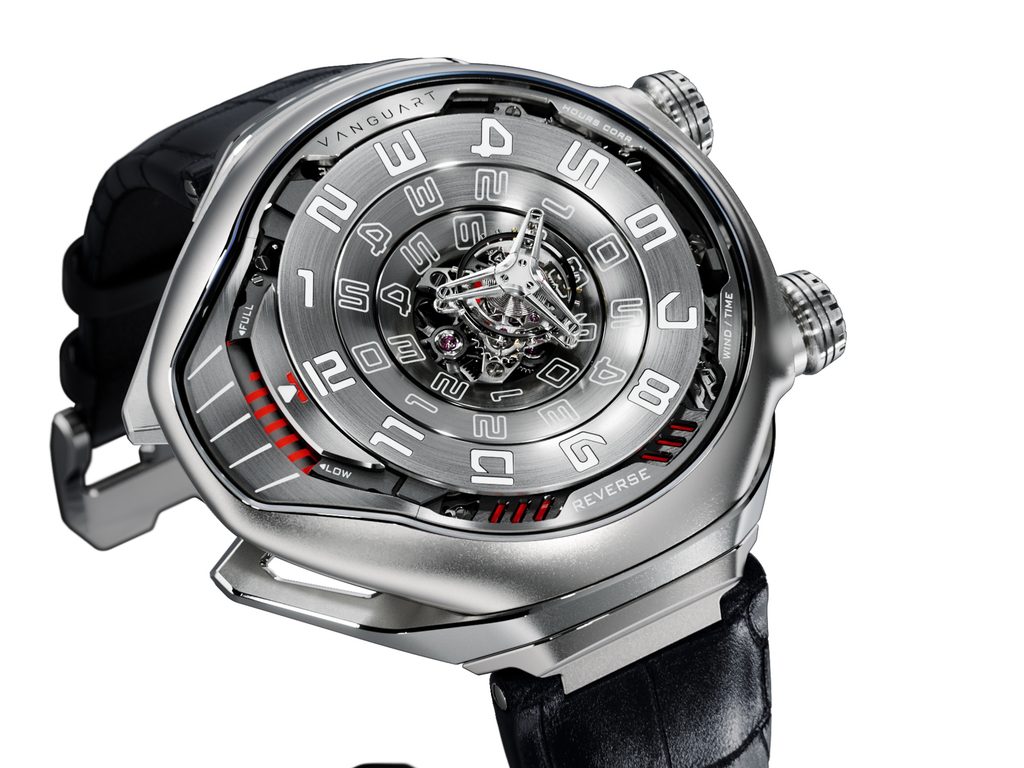
Vanguart Black Hole Tourbillon Joystick Crowns
The Orb from Vanguart is very cool. I have to fight against my inner conservative, but it’s just loads of fun on the wrist. The pink one that dropped in April was my pick of the bunch, but their surprising wearability and “modest flashiness” are exceedingly appealing on the wrist.
But I want to talk about crowns again. Specifically, the crowns of the Black Hole Tourbillon (which, in my mind, is the Vanguart watch). These time-setting knobs aren’t really crowns in the traditional sense at all. They are described as “joysticks” and boy, do they live up to that name. A 60 degree toggle forwards or backwards sets the discs (which take the place of hands on this model) wheeling in your choosen direction. It’s a sight to behold, utterly unique, and seriously, seriously cool.
This is not a cheap or simple thing to have achieved, but it is exactly what I expect these more avant-garde brands to be doing to justify your purchase. It’s exciting, it’s new, and it exemplifies the true spirit of horology that can, strangely, be summed up by JFK’s famous quote that reminds us that the purpose of watchmaking is to do things, “not because they are easy, but because they are hard.”