
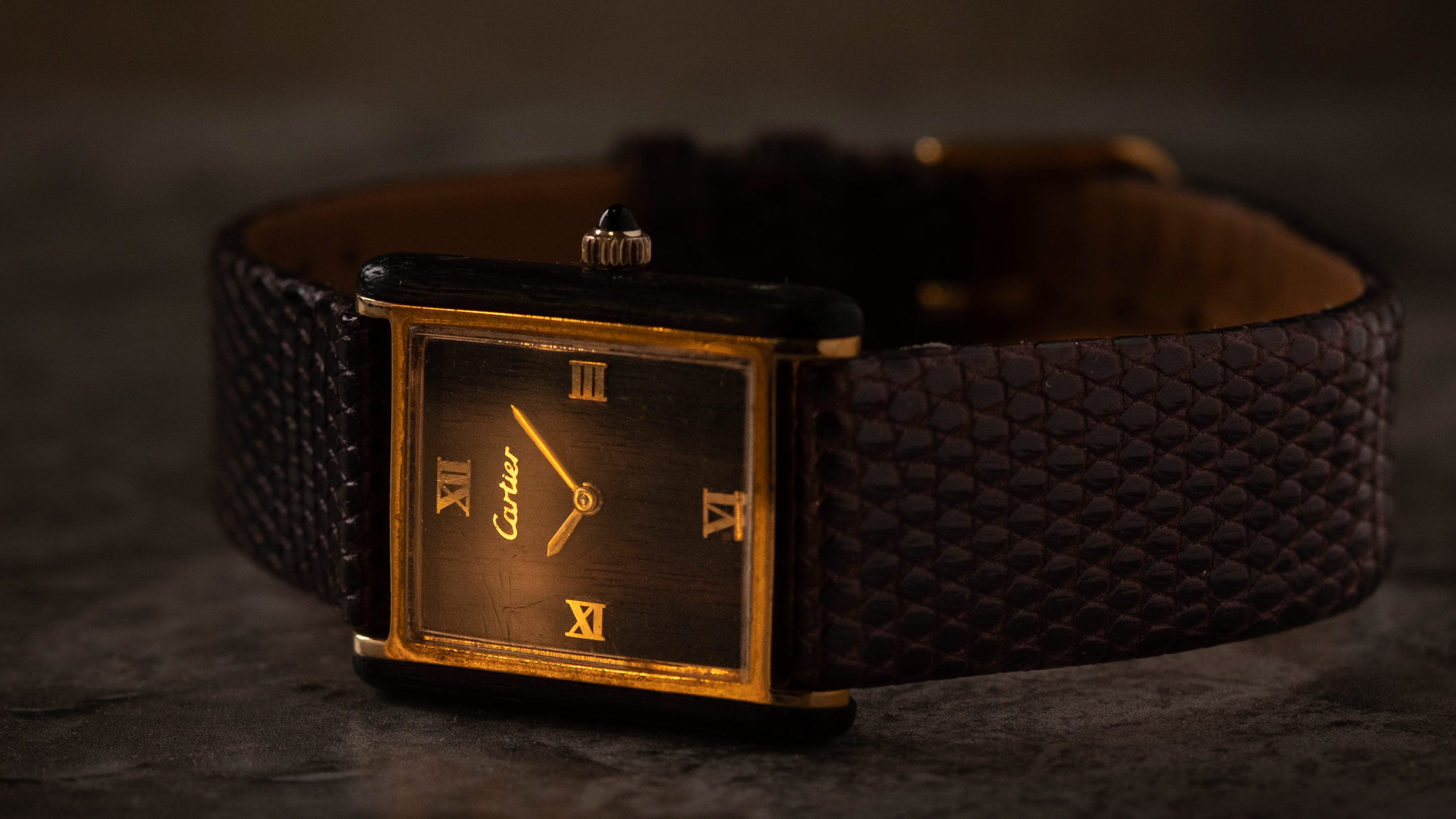
A long overdue hands-on with Cartier’s Pallisandre De Rio – but does the part-wood, gold-plated ‘Tank Organic’ cut it today?
We see watches in a multitude of materials, from lightweight titanium to heavyweight platinum; ultra-hard ceramic to soft gold. For better or worse however, wood generally isn’t among those materials. In the 1970s however, wood dials were a thing. Rolex used them in the Day-Date and Cellini line. Movado Zenith and Bulova joined in. In the 1970s it seems that wood was good.
Joining the wider watch world in the proverbial woodshop was Cartier, with their Pallisandre De Rio or Tank Organic as it is often called. The Pallisandre De Rio (PDR) was part of a pre-Must range of watches from the London and New York HQs. All gold-plated base metal and, in the case of the PDR, gold-plated and wood capped on the case sides. It’s undoubtedly a product of its era and I wanted to try one for the longest time. Well, it just happened that our Founder, Alan has one. “You can borrow it if you’d like”, so I did.
Before I go into more details of my experience with the Cartier, let first give you a potted history of the PDR. There were two models in the range, the ref. 20611 which had a 24x30mm case (the loaner was this size) and a ‘jumbo’ in 25x34mm (ref. 21611). They both had 20 microns of gold plating around their base metal cases and Brazilian Rosewood on the case flanks and dial. These dials have applied gold (coloured) Roman numerals and hands. Both have plastic crystals (and when I say plastic I mean like a blister pack with an action figure inside, not the Hesalite one finds on a Speedmaster).
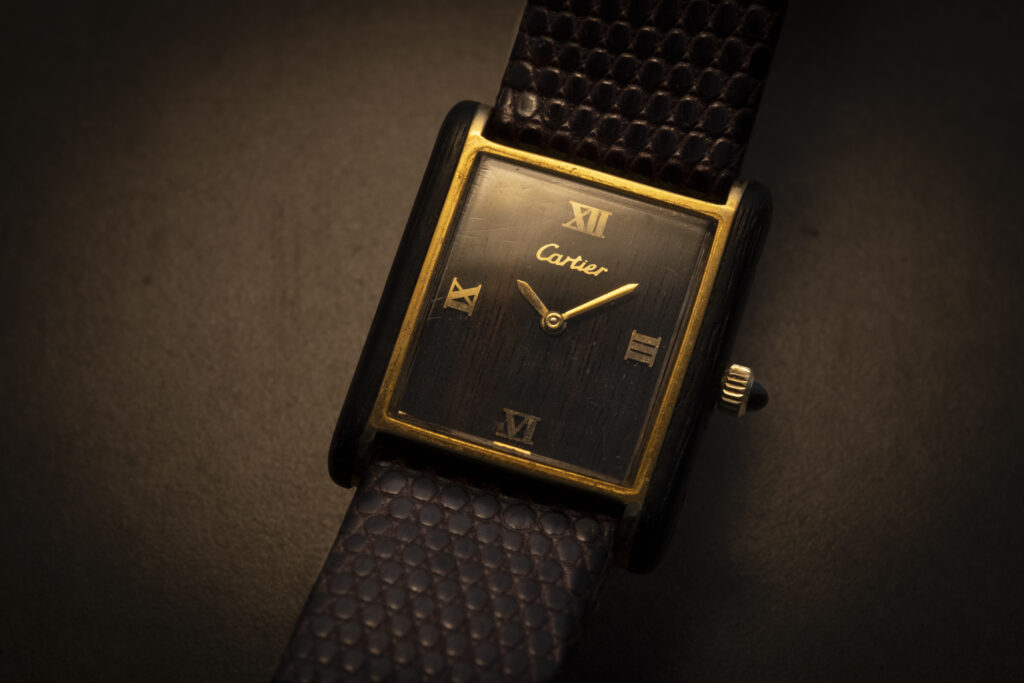
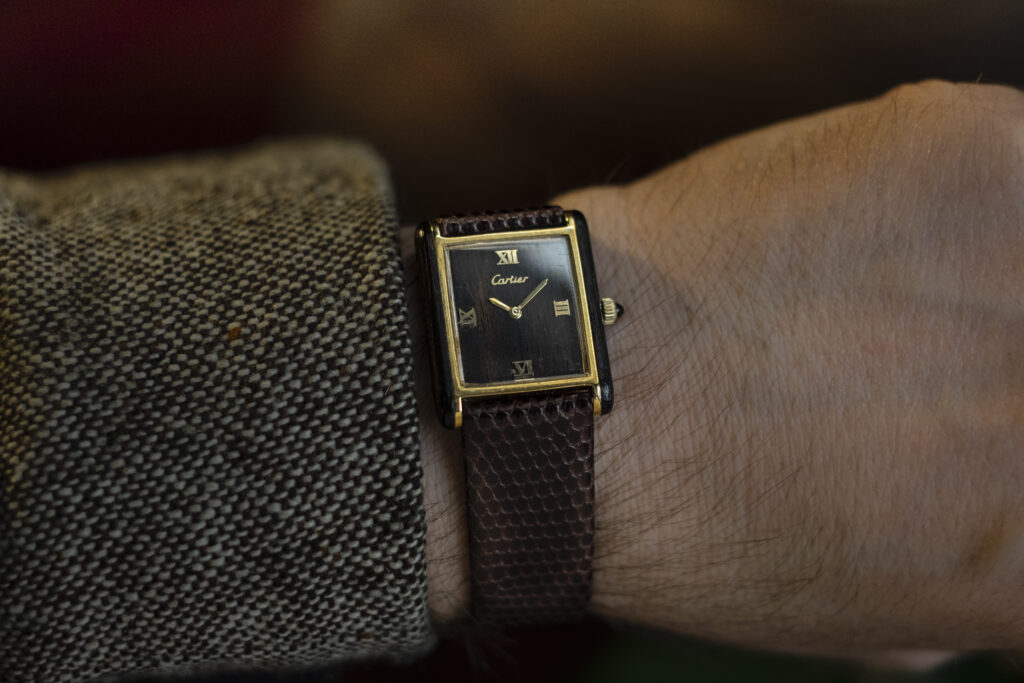
The gold tones and the rich warm wood give the Tank Organic a 1970s cocktail lounge feel and to me that was its appeal. Released in 1975 this Tank was discontinued only a year later, as were all the pre-Must watches, to make way for the actual Must de Cartier range and accessories that replaced them. This makes the PDR rare, and it is not just because of its short lifespan. It is also down to build quality – or lack of it.
The wood was prone to warp in humid conditions, which feels counterintuitive as Brazilian Rosewood grows in a rainforest. It reminds me of the flood damaged dinghies’ Del Boy sold on Only Fools and Horses. The crown, complete with a brown cabochon is the only time that the colour was used and almost certainly to match the Rosewood. It feels a little on the delicate side and does not fill me with overwhelming confidence; when winding the Cartier signed ETA 2512 movement that confidence is not improved.
This lack of Cartier quality certainly makes me feel the Pallisandre De Rio is little more than a fashion watch, and when you think of it in those terms you can enjoy it.
With all the negativity I have written about the Pallisandre De Rio, the actual wearing experience was just what I had expected and wanted. It was full of 1970s savoir faire, and it made me feel good. That, honestly, is what I want for a watch. That little extra confidence, that little more spring in one’s step as you go full boulevardier. It’s what Cartier does best and why the build quality here isn’t an instant dismissal. There is no shame in wearing a watch simply because you love how it looks and makes you feel.
No, the Pallisandre de Rio is not a great watch. But it’s very of its era and, more importantly, looks fantastic. It’s not trying to be anything other than that – and I will continue to wear it. Until Alan asks for it back.