
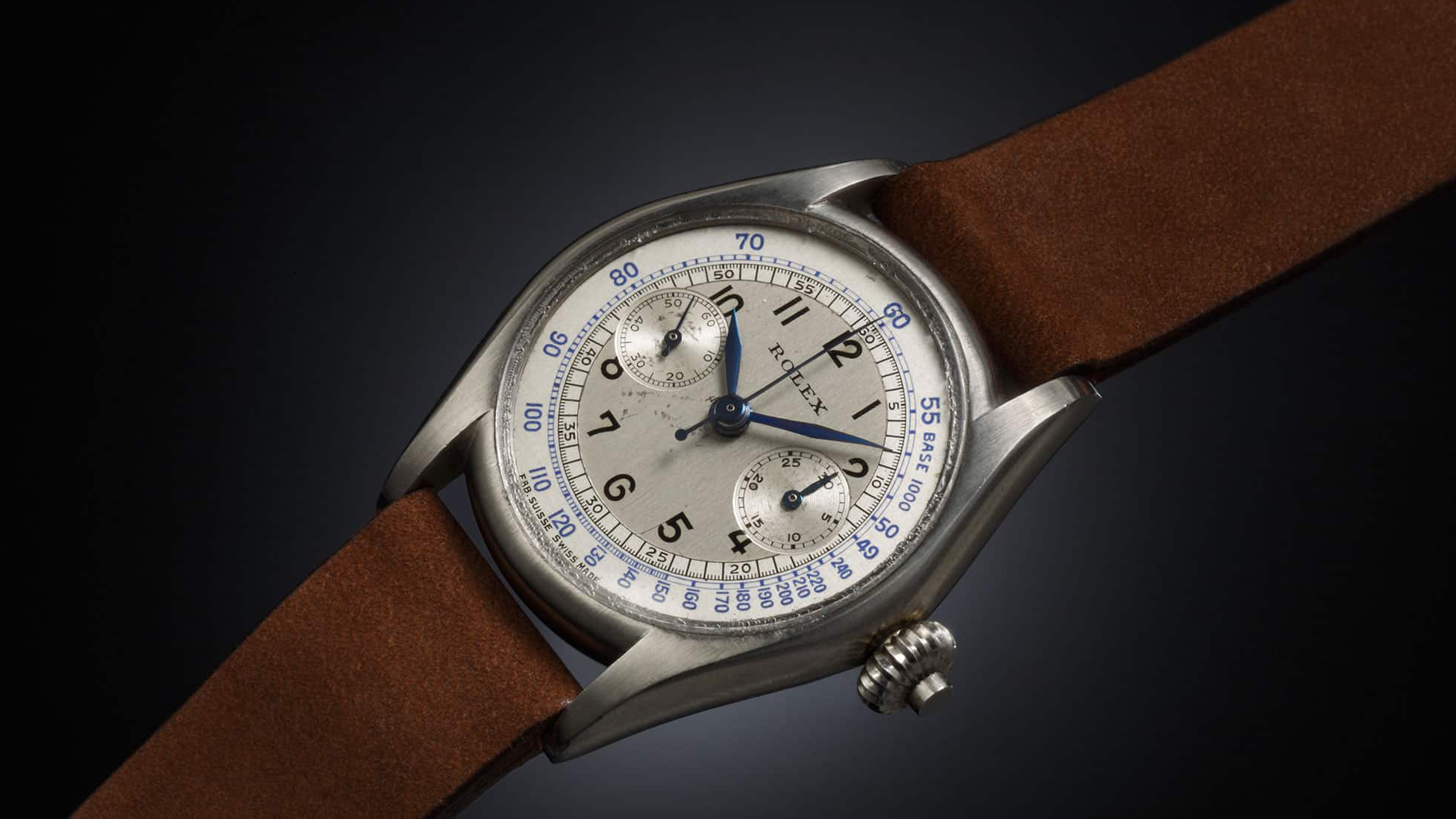
Before the Daytona Cosmograph became the Rolex chronograph, the “Baby Chronograph” and “Piccolino” proved that great things come in small packages
Long before the Daytona became the poster child of Rolex chronographs, or in fact any chronograph, the company was exploring a different expression of precision timing. The “Baby Chronograph” and “Piccolino” were diminutive watches that packed a mighty punch. Featuring remarkable movements and elegant designs, their place in the history of Rolex deserves far greater attention…
Today, the Rolex chronograph is almost inseparable from the Cosmograph Daytona. Its iconic Oyster case, screw-down pushers and association with motor racing have become defining elements of the brand’s identity. However, long before the Daytona appeared in 1963, Rolex had already developed a fascinating range of chronographs, many of which bear little resemblance to the watches that would eventually become its most celebrated creations.
Among the most intriguing are two particularly small references, namely the “Baby Chronograph” reference 2303 and the “Piccolino”, reference 3055. Both measure considerably less than a modern chronograph wristwatch, yet their modest proportions conceal a level of mechanical sophistication that was remarkable for the period. They also offer a glimpse of a Rolex that was willing to experiment with elegance, miniaturisation and technical ingenuity, without the sporting identity that would later dominate its chronograph collections.
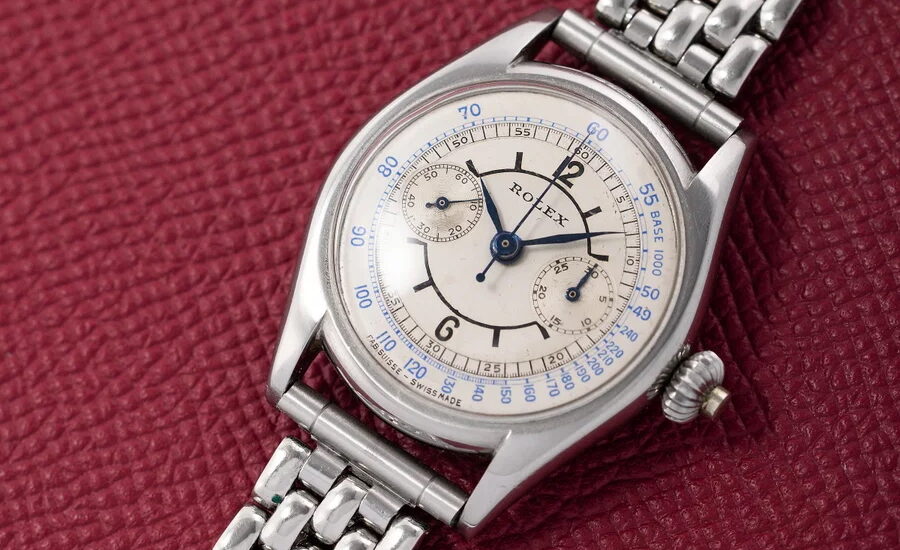
The Baby Chronograph ref. 2303
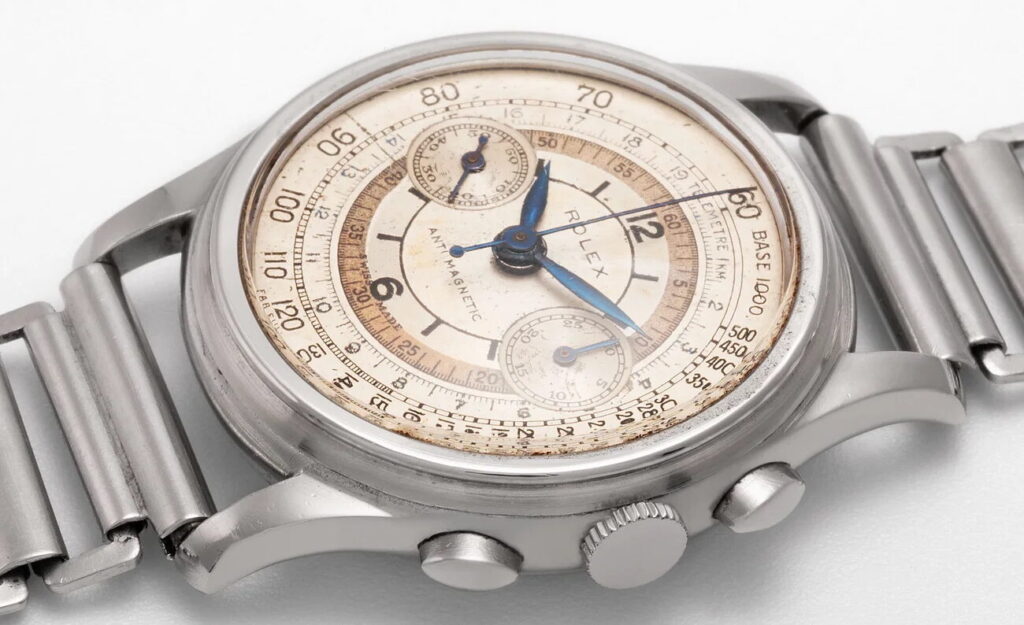
At just 28mm in diameter, the reference 2303 is an extraordinary little watch. Introduced during the 1930s, it belongs to the early generation of Rolex chronographs in which the stopwatch mechanism was operated by a single pusher integrated into the winding crown. This arrangement, commonly described as a monopusher, allowed the wearer to start, stop and reset the chronograph through successive presses of the same button. The result was a wonderfully discreet design. Without separate pushers protruding from the case, the “Baby Chronograph” could almost be mistaken for a conventional dress watch, were it not for the two subsidiary registers and the elaborate scales surrounding its dial.
Inside was the manually wound Valjoux 69, a compact column-wheel chronograph movement measuring just 10½ lignes, or approximately 23.35mm. Equipped with 17 jewels, it incorporated a running seconds display and a 30-minute chronograph recorder. Accommodating this mechanism within such a small wristwatch required considerable ingenuity, particularly at a time when the chronograph was still making the transition from pocket watches to the wrist.
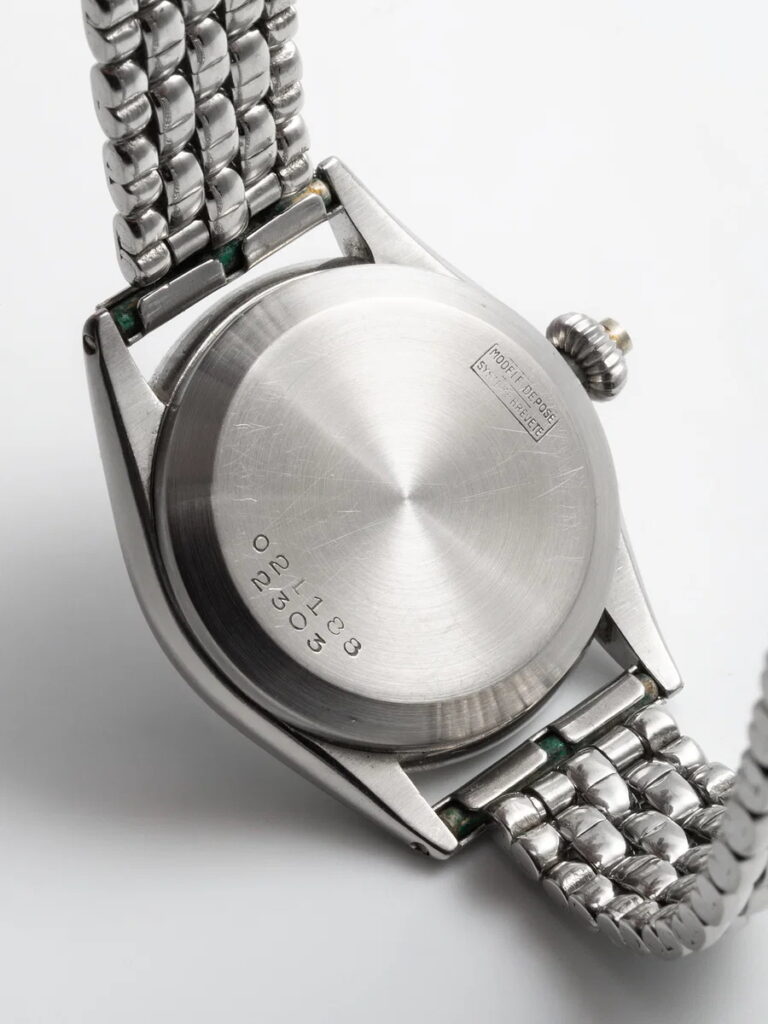
The cases were equally interesting. An example documented by Archivio Pucci Papaleo, numbered 022’323, features a stainless-steel case made by Robert Meylan, with a snap-on case back and a distinctive fluted crown incorporating the chronograph pusher. Its two-tone silver dial carries blued steel hands, a tachymeter scale and a finely divided seconds track. Despite its diminutive size, it remains a remarkably legible and purposeful instrument.
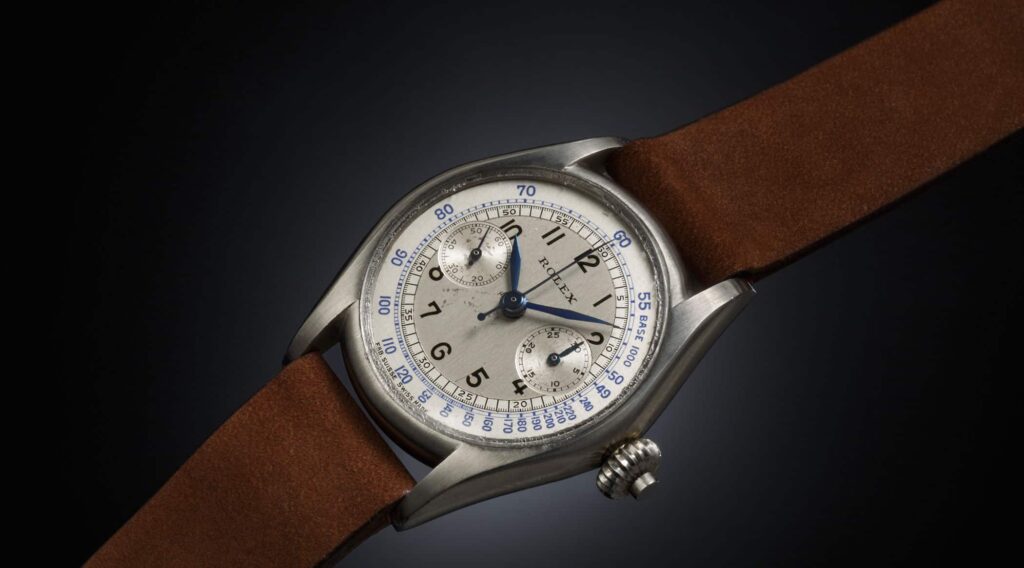
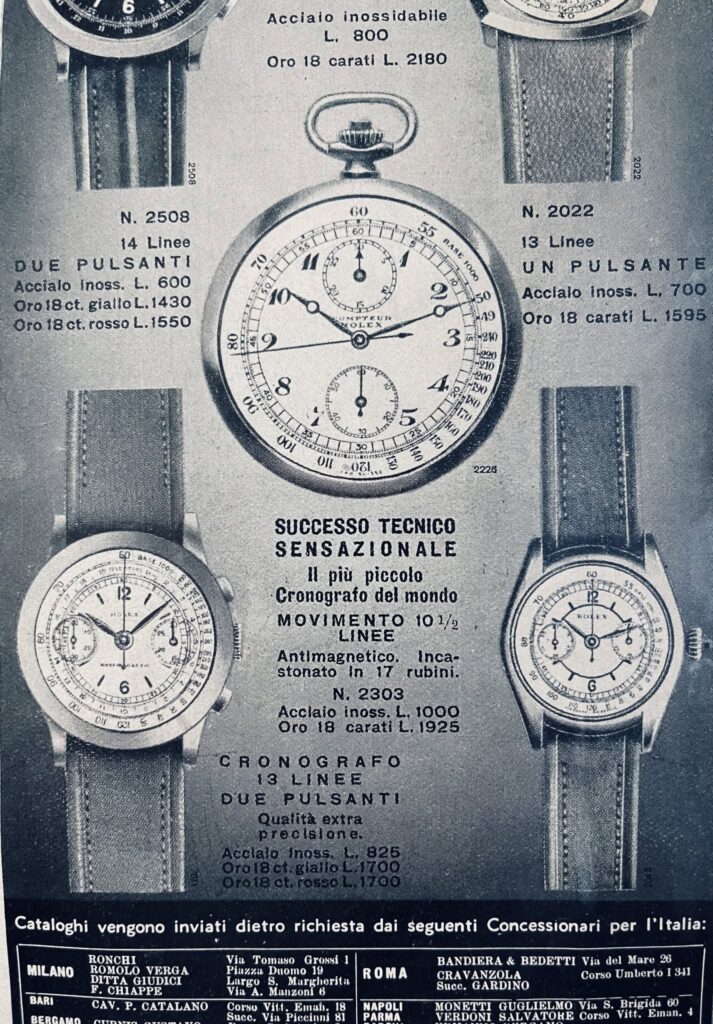
Perhaps the most revealing evidence of how Rolex regarded the “Baby Chronograph” comes from an original Italian advertisement of the period. Beneath the proclamation Successo tecnico sensazionale (a sensational technical achievement) Rolex presented the reference 2303 as Il più piccolo Cronografo del mondo, the smallest chronograph in the world. Rolex was charging a substantial premium for miniaturisation, positioning the “Baby Chronograph” as a technical accomplishment worthy of its own distinction.
Surviving examples demonstrate considerable variation in dial design, case material and finishing. Sector dials, applied numerals, contrasting registers and retailer signatures all contribute to the reference’s appeal. Examples have appeared in stainless steel and gold, including watches signed by retailers such as Ronchi in Milan and Kerby.
The rarity of these watches is evident from their relatively infrequent appearances at auction, although precise production figures remain uncertain. One particularly interesting stainless-steel example, case 021’188, sold at Bonhams in 2014 for £22,500 before subsequently achieving €175,000 at Monaco Legend Group. More recently, the Pucci Papaleo example, case 022’323, realised CHF 107,950 at Phillips in November 2026.
The “Piccolino” ref. 3055
If the “Baby Chronograph” represents Rolex’s fascination with miniaturisation, the reference 3055 demonstrates how that same ambition could be expressed through a more conventional two-pusher chronograph.
Known to collectors as the “Piccolino”, the reference measures approximately 30mm and occupies a particularly interesting position within Rolex history. Its non-Oyster case, refined proportions and elegant dial designs place it aesthetically closer to the dress chronographs of Patek Philippe than to the purposeful sports watches that would later define the Rolex chronograph.
The earliest examples appeared during the 1930s and featured distinctive olive-shaped chronograph pushers. These small, elongated buttons gave the watches an unmistakably period appearance, complementing their rounded cases, stepped bezels and gently curved lugs.
The reference subsequently appeared in a second principal configuration during the 1950s, distinguished by rectangular chronograph pushers and revised dial designs. Although the division between the two generations is well established in auction literature, surviving watches suggest that the precise chronology may be more complicated than a simple changeover. Examples with oval pushers have been attributed to the early 1950s, making it difficult to establish an absolute production boundary.
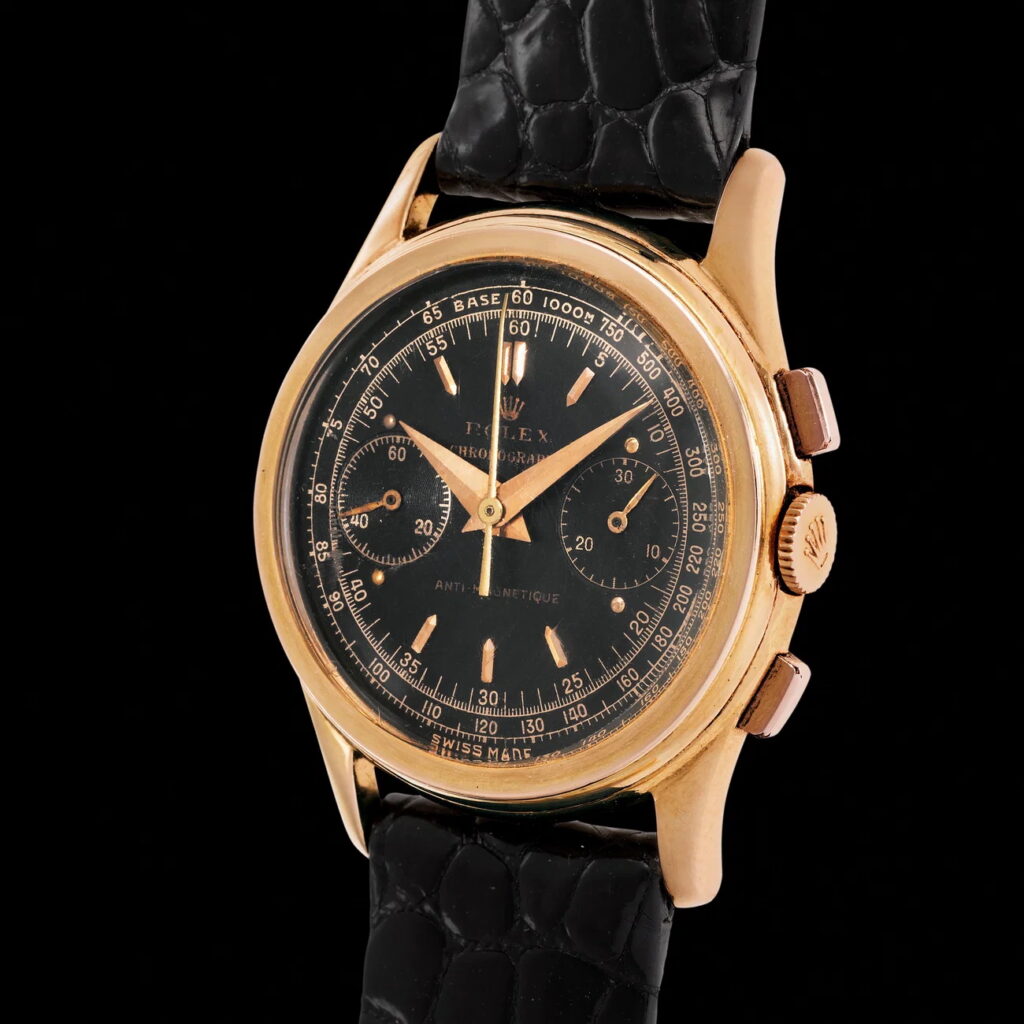
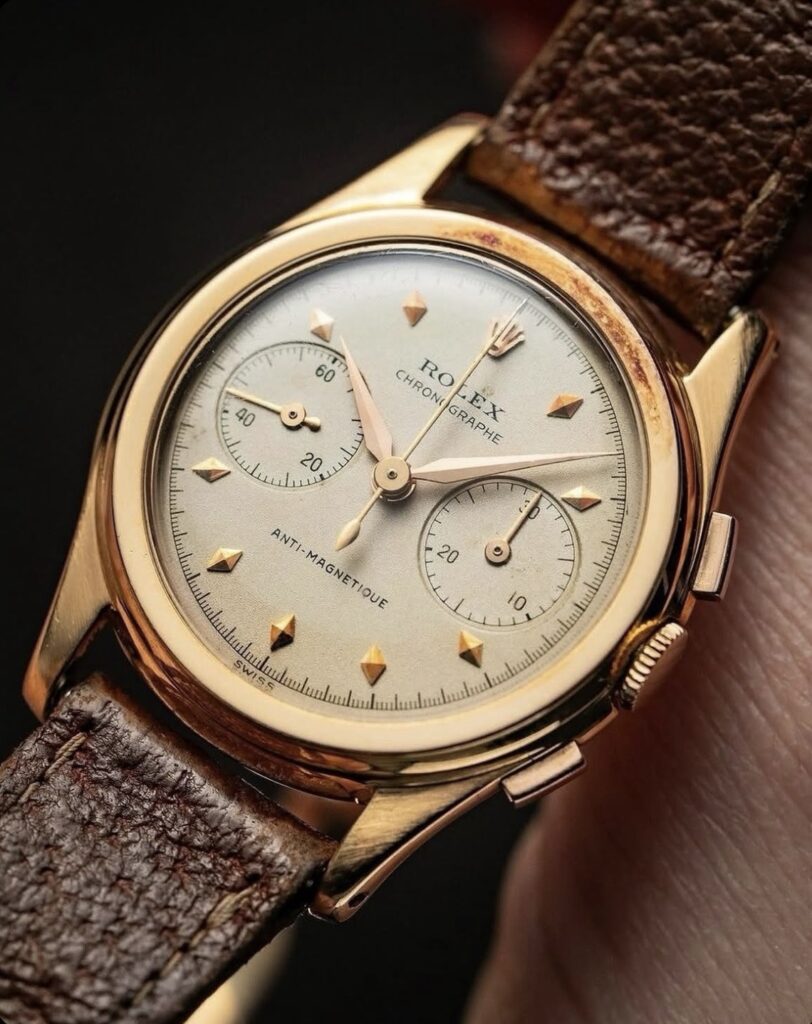
Throughout its evolution, however, the “Piccolino” retained its defining characteristic: a fully functioning, two-register chronograph housed within an exceptionally compact case.
Like the “Baby Chronograph”, it employed the Valjoux 69, with its column-wheel mechanism, running seconds and 30-minute recorder. The dial arrangements were remarkably varied. Early examples include striking two-tone sector dials with Arabic numerals, tachymeter and telemeter scales, whilst later watches display applied baton, dot or faceted lozenge hour markers, often accompanied by elegant alpha or dauphine hands.
One particularly attractive stainless-steel example, case 034’933, dating to circa 1935, appeared at Monaco Legend Group with a two-tone sector dial, double Swiss signature and both tachymeter and telemeter scales. Its olive-shaped pushers, concave fluted lugs and stepped bezel provide an excellent illustration of the early “Piccolino’s” distinctive character.
At the other end of the reference’s history are the pink-gold examples produced during the 1950s. These watches, with their rectangular pushers, applied gold markers and contrasting dial finishes, demonstrate how successfully the basic design adapted to changing tastes.
Production figures are difficult to establish with certainty. Auction literature frequently suggests approximately 500 examples in total, including around 200 in yellow gold and as few as 20 in pink gold. These numbers should be regarded as estimates rather than confirmed factory records, although the relative scarcity of surviving examples is beyond doubt.
Period pricing offers another indication of the “Piccolino’s” standing within the Rolex collection. Monaco Legend Group has documented an advertisement listing the stainless-steel version at 1,025 Italian lire and the gold version at 2,000 lire. In the same advertisement, an 18K gold chronograph pocket watch was priced at 1,920 lire. Once again, the smallest wrist chronograph commanded a premium over a considerably larger timepiece.
The watch on Enzo Ferrari’s wrist
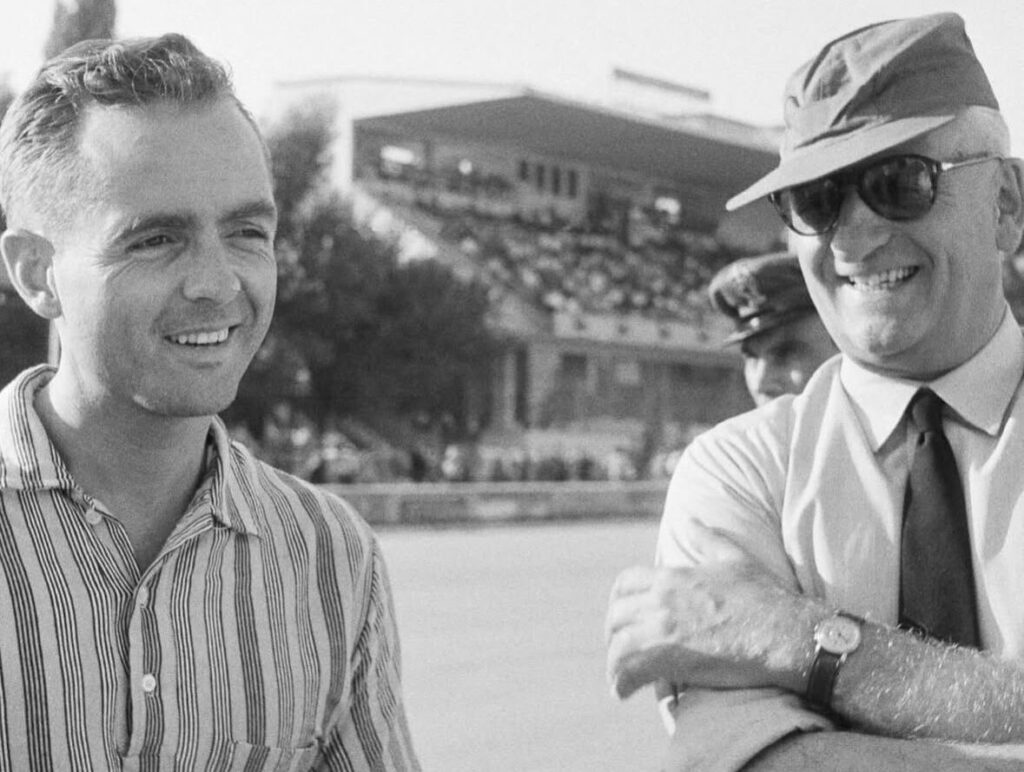
Yet perhaps the most compelling chapter in the “Piccolino’s” history concerns one of the twentieth century’s most celebrated figures in motor racing. Enzo Ferrari’s relationship with watches has often been overshadowed by the extraordinary machines that bore his name. Nevertheless, period photographs show Il Commendatore wearing a gold Rolex “Piccolino”, an intriguing choice for a man whose life revolved around precision, timing and mechanical performance.
The association is particularly appealing because the watch itself is so far removed from the modern image of a motorsport chronograph. There is no oversized case, contrasting bezel or overtly sporting design. Instead, Ferrari chose an elegant, compact chronograph whose technical sophistication was expressed with considerable restraint. The watch is illustrated in Time to Race by John Goldberger and Cesare Maria Mannucci, providing an important visual reference for the connection between Ferrari and the “Piccolino”.
It is tempting to draw a direct line between Ferrari’s watch and the later Daytona, but the relationship is more interesting than that. The “Piccolino” demonstrates that Rolex chronographs already had a place in the world of motor racing before the company developed the visual language and professional identity that would make the Daytona famous.
A different expression of Rolex
Neither the “Baby Chronograph” nor the “Piccolino” was destined to become a cornerstone of the Rolex collection. Their small cases, delicate proportions and non-Oyster construction belonged to a chapter of the company’s history that would gradually give way to more robust, purpose-built wristwatches. Yet it would be a mistake to regard them simply as evolutionary stepping stones towards the Daytona. They were accomplished watches in their own right, conceived at a time when miniaturisation was a genuine measure of watchmaking achievement.
Nearly a century later, they reveal a side of Rolex that is less familiar, more experimental and, in many respects, more surprising than the watches for which the company is best known. For collectors willing to look beyond the Oyster case and the familiar silhouette of the Daytona, these small chronographs offer a reminder that, like the Zerograph I wrote about last time, some of Rolex’s most ambitious ideas came in its smallest packages.